Attendance control for courses and training
Limited places per intake, enrolment paid online, and certificates that reflect the hours each student was actually in the room — from sign-up to certificate, without a paper sign-in sheet.
- Quotas per intake: limited places by group and session
- One-off or repeating sessions for multi-day courses
- Enrolment paid online, into your own gateway
- Certificates built from entry and exit scans
The sign-in sheet is the weakest part of accredited training
A paper list proves that someone wrote a name. It does not prove they were there, and it certainly does not prove for how long.
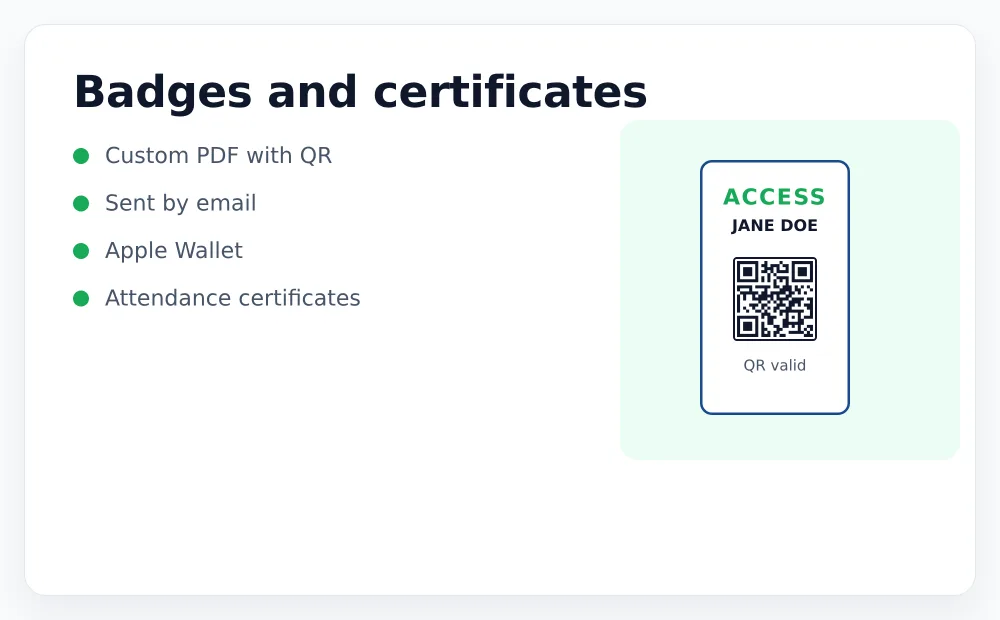
Every QR scan is recorded the moment it happens and feeds the certificate directly. Nobody transcribes anything, so nobody mistypes anything — and if a student disputes their hours, the scan history answers it with times and doors.
Three things that go wrong with attendance hours
Night sessions
A class from 22:00 to 02:00 is four hours. Systems that group by calendar day split it in two and certify zero. Ours does not.
Someone forgot to scan out
Flagged as an incomplete session instead of counted as zero hours, so the tutor can correct it rather than discover it at certificate time.
Partial attendance
Hours per day and a total, so a minimum attendance requirement can be checked against what actually happened.
Places, waiting lists and payment
Each intake has its own capacity. When it fills, the registration page stops accepting people instead of overbooking a room.
If the course is paid, the enrolment is charged online and the money goes straight into your own gateway account — no commission on it.
Students receive their QR badge on enrolment, valid for every session of the course.
Try it with one intake
Set up a course with two sessions, enrol yourself and see the certificate it produces.